Rabbit Breeding: A Complete Guide from Mating to Weaning
Rabbit breeding made simple: discover how smart farm management tracks every stage of the breeding pipeline — from AI pair suggestions to automated weaning reminders.
Featured

Rabbit breeding is one of the most critical processes on any farm. The survival rate of kits, the health of does, and the overall profitability of your rabbitry all depend on how well each stage is managed. This guide walks you through every step — from selecting a breeding pair to fully weaning the litter — and shows how each stage works inside the rabbit farm management app.
1. Selecting a Breeding Pair: AI Recommends Who to Breed with Whom
A successful litter starts with the right pairing. Key factors to consider:
Age — Does should be at least 4–5 months old; bucks 5–6 months.
Health — Both animals should be active and show no signs of illness.
Productivity — Average litter size, kit survival rate, interval between litters.
How it works in the app
When you select a buck for a new pair, the AI analyzes all available does and returns the top 3 recommendations with scores and explanations: why this doe is a good match, what her productivity looks like across previous litters. This isn't a random list — the system draws on the real history of your farm.
For the farmer, this means fewer guesses and more informed decisions. Especially useful when managing 10 or more animals, where comparing stats manually becomes impractical.
2. Mating and Pregnancy Tracking
After mating, the countdown begins. Rabbit gestation lasts 28–32 days (30 days on average).
Key steps after mating:
Record the mating date immediately
Perform a palpation check around day 12–14 to confirm pregnancy
Prepare the nest box around day 24–26
How it works in the app
As soon as you register a mating, the app automatically launches a breeding pipeline — a sequence of stages from mating to cycle closure:
PLANNED → MATED → NEST FORMED → NEST BOX INSTALLED → BIRTH RECORDED → NEST BOX REMOVED → KITS SEPARATED → CLOSED
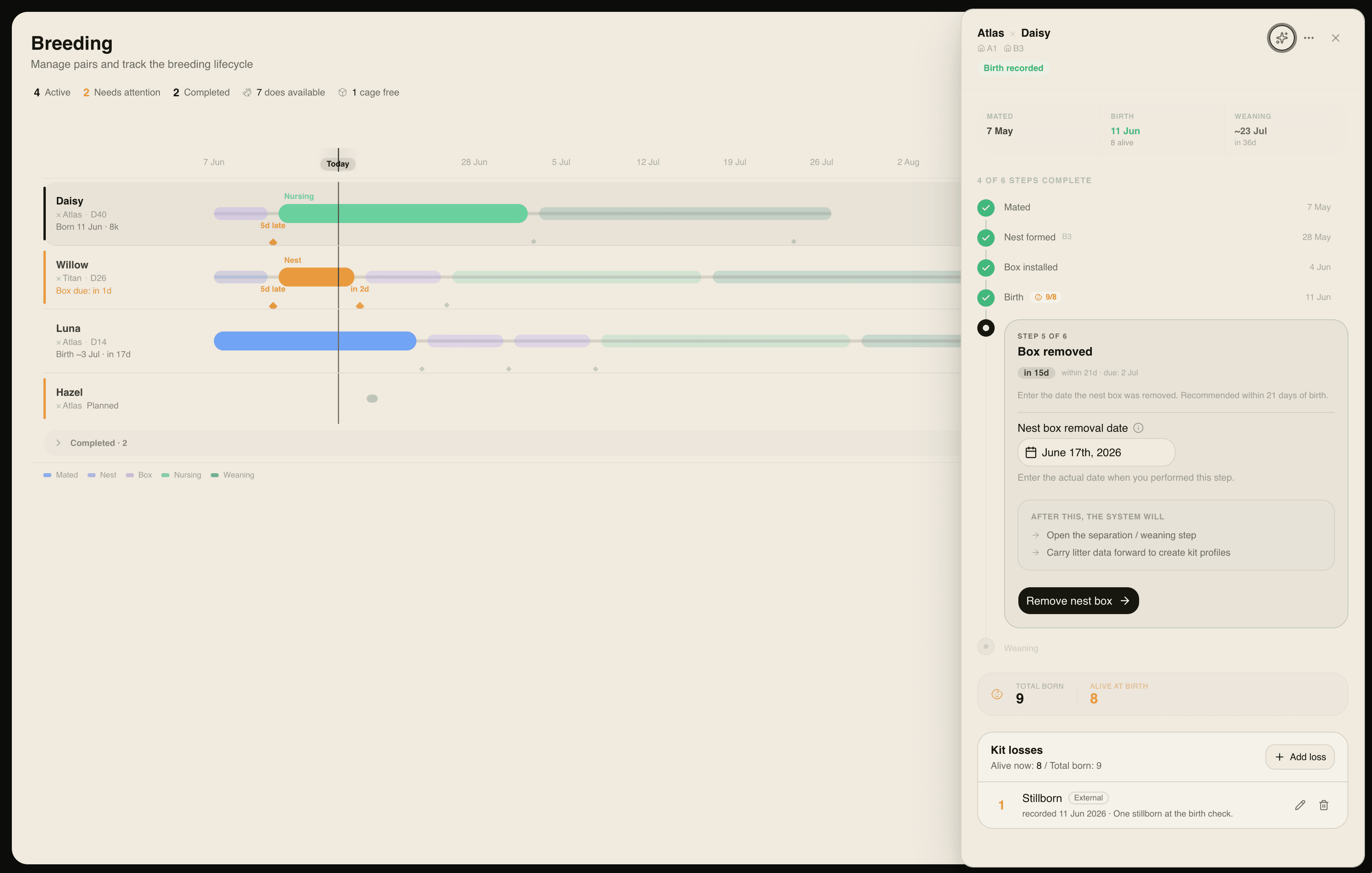
At each stage, the system reminds you what to do next and when. Tasks are created automatically — no manual note-taking required.
Customizable for your farm
All timelines in the app are adjustable. In the Farm Rules section, you can set:
Gestation length (default: 30 days)
Separation age for kits
Weaning age
Minimum rest period between litters for does
Target market weight
This matters because different breeds have different biological norms. Your settings become the single source of truth for the entire app — for reminders, automatic tasks, and AI recommendations alike.
3. Nesting and Kindling
Place the nest box 3–4 days before the expected kindling date. The doe will begin pulling fur to line it — this is normal nesting behavior.
During kindling:
Avoid disturbing the doe unnecessarily
Check the nest 12–24 hours after birth
Count the kits and remove any stillborns
Normal litter size: 6–10 kits. If there are more than 10, consider fostering some kits to a doe with a smaller litter.
How it works in the app
As the expected kindling date approaches, the app sends a reminder to install the nest box. Once you confirm the birth, the cycle advances to the next stage and the system is already preparing the next reminder — nest box removal.
4. Recording the Birth and Tracking Kit Losses
After kindling, log:
Number of kits born (live and stillborn)
Cause of death if any kits are lost (crushing, starvation, illness)
How it works in the app
Tracking losses is more than record-keeping. After several litters, the app builds loss analytics by cause: which cause appears most often, which does have consistently higher losses. This lets you spot systemic issues and act on them — adjust the diet, change housing conditions, or reconsider a specific doe.
5. Separation vs. Weaning: Why They're Not the Same
Many beginners confuse these two steps and make the costly mistake of weaning kits too early.
Separation happens around day 42–45. Kits are moved to a separate cage but are not yet fully transitioned to solid food. Their digestive systems are still developing.
Weaning — the complete end of nursing — happens around day 60–70. Only after this point is the doe considered free and ready to be bred again.
Why does this matter?
Weaning too early causes stress and digestive issues in kits, significantly increasing mortality. Weaning too late exhausts the doe and weakens her next litter.
How it works in the app
Separation and weaning are tracked as two distinct stages, each with its own automated reminder. When it's time to separate the kits, you get a notification. Two to three weeks later, a weaning reminder follows — and after weaning is confirmed, the doe's status automatically updates to "available" and she appears in the list of does ready for the next pairing.
Both timelines are adjustable in Farm Rules to match your breed's specific biology.
6. Analytics: Which Does Are Most Productive?
After a few litters, your records become valuable data:
Average number of kits per litter
Kit survival rate
Weight gain before weaning
Interval between litters
How it works in the app
The app builds a doe productivity ranking automatically. You can see at a glance which does are generating the most value and which should be culled — without manual calculations or spreadsheets. The same data feeds the AI pair selection: the system knows which does perform best and factors that into its recommendations.
There's also a Gantt timeline — a visual chart of all active breeding pairs at once. One look tells you where each pair is in the cycle, who's approaching kindling, and who's waiting for weaning.
Final Thoughts
Every stage in this process matters. Miss a date or mix up separation with weaning, and you risk losing kits, exhausting your does, or simply wasting time. The app guides you through each step, reminds you what needs to happen and when, lets you customize all timelines for your breed, and turns your daily records into real farm analytics over time.

